Friday, 19 April 2019

2nd Sunday (Divine Mercy) of Easter

The second reading today makes clear the implications of the resurrection. The risen Christ proclaims: "I was dead, but see, I am alive forever and ever; and I have the keys of Death and Hades." (Rev 1: 18) The resurrection of our Lord Jesus Christ was not a resuscitation or restoration of life, as in the case of Lazarus. Jesus reveals his divinity, foreshadowed in the Transfiguration, as a permanent and eternal state of being. He takes up his life and no one can take it from him again. It is relevant not only to him but to the whole of Creation. His resurrection is a cosmic event because up to this point in time the only possible outcome for any living being was physical death and annihilation. Jesus resurrection makes him Lord of the Universe. It is now his life that rules. He holds the key to immortality. All human beings will come before him to give an account for the life they have led: "For all of us must appear before the judgment seat of Christ, so that each may recompense for what he has done in the body, whether good or evil." (2 Cor 5: 10) This "us" includes Pontius Pilate, Pol Pot. Genghis Khan, Adolf Hitler, Mao Tse Tung and millions of others who have offended greatly against  God's love. We cannot, however, be complacent that we will inherit the promise of resurrection ourselves as if it is a right or simply by being baptized. At Vatican II the Council Fathers warned: "All the sons of the Church should remember that their exalted status is to be attributed not to their own merits but to the special grace of Christ. If they fail moreover to respond to that grace in thought, word and deed, not only will they not be saved but they will be the more severely judged." (Lumen gentium, 14) As the writer of the Letter to the Hebrews tells us: "It is a fearful thing to fall into the hands of the living God." (Heb 10: 31)

Image result for divine mercy

Wednesday, 10 April 2019

Easter Sunday

The gospel relates: "Early on the first day of the week, while it was still dark, Mary Magdalene came to the tomb." (Jn 20: 1) We know from the other gospels that she had come to complete the customary preparations for burial that had been cut short by the Passover on Friday afternoon. What must have been in her heart at the point!? I think that most of us have an inkling of what it must have been like because through the suffering and deaths of loved ones we too have in different ways experience the cross. We commemorated the tragedy of the cross on Good Friday sacramentally. We now come to sacramentally enact the resurrection at the Easter Vigil and the Sunday Mass. The question is, however, as we have known the cross, have we likewise known something of the power of the Risen Christ?  How do I know if I have experienced this power? One way to verify this is to reflect on what I am focused in my life. Am I taken up with material things and status or do I set my hearts on intangible and spiritual realities?: "If you have been raised with Christ, seek the things that are above, where Christ is, seated at the right hand of God." (Col 3: 1) This is not a question of day dreaming or fantasy. If I encounter Christ and follow him I will know the power of the Holy Spirit now and have a sure and certain hope that I will share in his glory in the age to come: "When Christ who is your life is revealed, then you also will be revealed with him in glory." (Col 3: 4) Another way  to determine the impact of the resurrection in my life is whether I have known his forgiveness in my life: "All the prophets testify about him that everyone who believes in him receives forgiveness of sins through his name." (Acts 10: 43) May you all know the power of the Risen One this Easter and may that experience fill you with the joy and gratitude that only Christ can give.

Image result for easter morning

Easter Reflection 2019


Welcome to the Easter ceremonies in the Catholic Parish of Whanganui. This time of the year is a wonderful opportunity to not only be reminded of but to sacramentally re-enact the saving events of Jesus’ passion, death and resurrection: “For if we have been united with him in a death like his, we will certainly be united with him in a resurrection like his.” It is through being incorporated into the Body of Christ through baptism that we have the pledge of our redemption from sin and death as well as the power of his resurrection at work in our lives here and now. Through faith and the liturgy we are caught up in a universal and cosmic hymn of praise and love motivated and informed by the plan of the Holy Trinity to unite all things in Christ when death itself is done away with: “Then comes the end, when he (Jesus) hands over the kingdom to God the Father, after he has destroyed every ruler and every authority and power. For he must reign until he has put all enemies under his feet. The last enemy to be destroyed is death.” (1 Cor 15: 24-26)

Why is it that so few people in New Zealand are not drawn to this free gift of life and the hope of immortality in Christ Jesus? Many people have lost a sense of the spiritual and of religion. We, too, can feel bereft, scandalized and disheartened by sin, evil and death. Yet, all of us are under a sentence of death and, indeed, the whole of the Universe will inevitably come to an end: “For the creation was subjected to futility , not of its own will but by the will of the one who subjected it, in hope that the creation itself will be set free from its bondage to decay and will obtain the freedom of the glory of the children of God.” (Rm 8: 19-21) The seeds of eternity sown by God in the depths of the human heart long to germinate and flourish so that the faith we hold, the hope we bear, and the love we live will endure in eternal life. We dread to think that all we have and are is condemned to darkness and annihilation – such is the absurdity of life in a lonely and meaningless Universe governed by blind evolutionary impulses: “For if the dead are not raised, then Christ has not been raised. If Christ has not been raised, your faith is futile and you are still in your sins. Then those also who have died in Christ have perished. If for this life only we have hoped in Christ, we are of all people most to be pitied.” (1 Cor 15: 16-19)

In such times, we can look to Pope Francis as a man of courage, mercy and love. The phenomenon of nominal or cultural Christianity is dying. He encourages, in his document Evangelii Gaudium, us and all Christians to look to or renew their encounter with Christ “… by personal testimony, proclamation of the kerygma (foundational teaching), and the missionary action of the community.” This encounter invites of them the initial response of a conversion whereby they: “… decided to be His (Jesus) friend and go with him, changing how they think and live, accepting the cross of Christ, conscious that dying to sin is attaining life.” As a result, we are all called to progress in discipleship: “The person constantly matures in knowledge, love, and following of Jesus the master, and delves deeper into the mystery of His person, his example, and his teaching.” This reinforces our experience of communion where: “Like the early Christians who met in community, the disciples take part in the life of the Church, and in the encounter with brothers and sisters, living the love of Christ in solidarity, in fraternal life.” This ongoing process of renewing and living out our resurrection faith is not just for ourselves but for mission: “As they get to know and love their Lord, disciples experience he need to share with others their joy at being sent, at going to the world to proclaim Jesus Christ, dead and risen, to make real the love and service in the person of the neediest, in short, to build up the Kingdom of God.” (EG #120)

I encourage everyone, regardless of their stage of life or spiritual journey, to join in this process of deepening and activating faith which will be put into action in the coming months and years.
Christ is risen! He is risen, indeed! Alleluia, alleluia!

Happy Easter and God bless!

Fr Marcus

Image result for resurrection

Monday, 8 April 2019

Passion (Palm) Sunday

In the Gospel for the entry into Jerusalem Luke's gospel is unique in having the crowd cry out: "Blessed is the king who comes in the name of the Lord! Peace in heaven, and glory in the highest heaven." (Lk 19: 37) This remind us of the heavenly host that appeared to the shepherds upon Jesus birth: "Glory to God in the highest heaven, and on earth peace among those whom he favours." (Lk 2: 14) On both occasions we are invited to join in the rejoicing of those who witness the advent of the Messiah. This has implications not just to the people in Jerusalem, gathering for the Passover, but for the whole world. Indeed, the whole of Creation is caught up in the moment. The Pharisees, onlookers in the crowd, try to dampen the crowd's enthusiasm, however, Jesus replies: "I tell you if these were silent the stones would shout out." (Lk 19: 40) This reminds us that these events which took place in history were also acts of God bringing about the plan of salvation which led to us being freed from the tyranny of sin and death. As we gather for Palm Sunday may we too rejoice to have such a wonderful Lord and Saviour and know something of the enthusiasm of that jubilant day.
Image result for palm sunday

Monday, 1 April 2019

5th Sunday of Lent

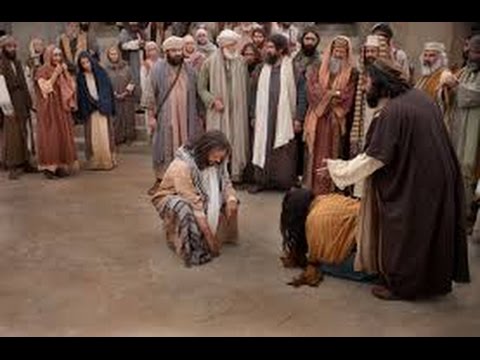
In today's Gospel Jesus is shown as seated in the Temple teaching the people who come to him. The scribes and Pharisees are dismayed that Jesus is attracting the people and are afraid that he will lead them astray. They even acknowledge that he, the carpenter's son from Nazareth, has some influence by addressing him, even if only sarcastically, as "Teacher." (Jn 8: 4) Jesus has already shown his Messianic credentials by working various signs and healing many people. His opponents need to nip this challenge to their authority in the bud. To do this they look for a case where they can make Jesus look as being lax in his interpretation of the law or force him to back track on his teachings of mercy and love by condemning the woman caught in adultery. Their insistent questioning (Jn 8: 7) shows that they think they are on to a winner. They have no care for the woman. She is merely a pawn in their attempt to embarrass Jesus. Jesus' opponents are confounded, however, when he turns the tables by asking them to see their own sin before they condemn that of the woman. The challenge is now that they either put themselves in the place of God by asserting their sinlessness or hold back, thus having their hypocrisy revealed. They walk away.This begs the question: do I put Jesus to the test by gossiping and accusing others? Jesus, for his part, said to Nicodemus: "Indeed, God did not send the Son into the world to condemn the world, but in order that the world might be saved through him." (Jn 3: 17)  

Image result for woman caught in adultery

Wednesday, 20 March 2019

4th Sunday of Lent

The complaint of the elder brother, in the Gospel today, is: "Listen! For all these year I have been working like a slave for you, and I have never disobeyed your command; yet you have never given me even a young goat that I might celebrate with my friends." (Lk 15 ; 29) Elsewhere, in the same Gospel, Jesus speaks of the attitude of a master to a disciple: "Do you thank a slave for doing what was commanded? So you also, when you have done all that you were ordered to do, say: 'We are worthless slaves; we have done only what we ought to have done!'" (Lk 17: 9-10) It seems that being a disciple of the Lord is not a rewarding occupation! However, let us listen carefully to the response of the Father: "Son, you are always with me, and all that is mine is yours." (Lk 15; 31) What a blessed thing it would be to always in the presence of the Lord! Think of what it is to possess all that is his - the resurrection! When we have truly encountered Christ and given ourselves over to him our personal attributes and prosperity mean nothing. Our social status and reputation pale into insignificance. St Paul writes: "Yet, whatever gains I had, these I have come to regard as loss because of Christ. More than that, I regard everything as loss because of the surpassing value of knowing Christ Jesus my Lord. For his sake I have suffered the loss of all things, and I regard them as rubbish, in order that I may gain Christ and be found in him...". (Phil 3: 7-9)

Image result for prodigal son

The Annunciation of the Lord

Wherein lie the foundations of the Church? Is it money, buildings, religious ceremonies or other material things? No, it lies in the consent and testimony of two historical individuals who freely chose to cooperate with God's plan of salvation. Today we celebrate the first of these: "Here am I, the servant of the Lord; let it be with me according to your word." (Lk 1: 38) On June 29, we will celebrate the second: "You are the Messiah, the Son of the living God." (Mtt 16: 16) Our Lady and St Peter are essential to the structure of the Church. Not only in those moments of faith but throughout the mission of the Lord and at Pentecost where they had the Holy Spirit descend upon them as they prayed with the rest of the followers of Jesus in the Upper Room. It is incumbent on us to imitate these foundation disciples especially in the way they trusted in God's plan for them and allowed the Holy Spirit to do such great works despite their lowliness.

Image result for annunciation