Writing in 1959, Pope St John XXII wrote:I"As it is said of
the short dialogue between the angel and Mary in the sacred silence of
Nazareth, that sums up the mystery of the Incarnation and the Redemption of the
world, thus the Tu es Christus filius Dei
vivi [You are Christ Son of the living God] of Peter and the reply of
Jesus, Tu es Petrus et super hanc petram
aedificabo [You are Peter and on this rock I will build] established the
structure of the Catholic Church. In fact, by means of the divine Motherhood of
Mary, the Word of God was made man and redemption and salvation occurred. With
the act of faith in Christ, Son of the living God, the response of Tu es Petrus [You are Peter] of Jesus
and with it the institution of the Church. Thus the salvation of the world is
achieved." From this we can see that the dialogue between Jesus and Peter at Ceasarea Phillipi was not just a private conversation. It is constitutive of the Church. To this end it is impossible to imagine the Church without the Petrine office just as we cannot imagine the Incarnation without the cooperation of Our Lady.
Monday, 21 August 2017
Monday, 14 August 2017
Twentieth Sunday in Ordinary Time
In the Gospel today I feel compelled to admire the persistence and temerity of the Canaanite woman. She knows that she is an outsider yet she will not let anything stop her from getting to Jesus to put forward her request. Often we see people in the Gospel coming forward to Jesus to ask him for a favour however, on this occasion, the woman like Bartimaeus is so desperate that she is shouting. Like him she is disregarded as an inconvenience and others, who are closer to the Lord, discourage her. Also, like him, she has an incomplete sense of who he is calling him; "Lord, Son of David." (Mtt 15: 22) The Lord himself, initially, does not seem interested. Yet, the woman comes forward and kneels at his feet. Her rejoinder to his quip about throwing the children's food to the "puppies" earns even his admiration. All this goes to show that when we want something and have faith we will not give up easily. Did not Jesus tell us the parable of the importunate widow? (Lk 18: 1-8) We need to imitate the humility and persistence of the Canaanite woman so as to break though our own internal barriers of faith to a new level of trust in God and his care for us even when it seems, on occasion, that he doesn't seem to care?
Sunday, 13 August 2017
Feast of the Assumption
One of the dangers I perceive in honouring the Assumption of the Blessed Virgin Mary, without remembering her role as exemplar of the Church, is that we separate her off from the rest of humanity. She is not a goddess. She has priority in our affections and our esteem however, like our own mothers, her humanity remains only it has been glorified in the resurrection in a way that we pray, in due course, all of us will be. Vatican II tells us: " In the interim just as the Mother of Jesus, glorified in body and soul in heaven, is the image and beginning of the Church as it is to be perfected is the world to come, so too does she shine forth on earth, until the day of the Lord shall come, as a sign of sure hope and solace to the people of God during its sojourn on earth." (Lumen Gentium, 68) It is clear from today's Second Reading that the resurrection of the dead will not happen all at once. St Paul tells us: "For since death came through ahuman being, the resurrection of the dead has also come through a human being; for as all die in Adam, so all will be mnade alive in Christ. But each in his own order: Christ the first fruits, then at his coming those who belong to Christ." (1 Cor 15: 22-23) Our Lady gives us hope that we can join Christ in his glory if we imitate her in her holiness, docility to God's will and faitfhfulness to her Son. Her intercession assists us in our prayers and inspires us to greater devotion. She does indeed proceed us but this was so that she might light the way to those who follow.
Thursday, 6 July 2017
19th Sunday in Ordinary Time
The walking of Peter on water is a curious story in the Gospel. We are accustomed to thinking of the Lord and his miracles but we do not think of others as participating directly in them. Individuals are the objects of miraculous activity not subjects of it! Yet, here we have Peter being given the chance to join the Lord as he walks on the Sea of Galilee! It is amazing the Peter should even ask to join the Lord but how much more so that the Lord should say "yes"! Things become business as usual and it does not take long: "But when he noticed the strong wind, he became frightened, and beginning to sink, he cried out, 'Lord save me'! " (Mtt 14: 30) Is it the case that I get the "speed wobbles" when I see the Holy Spirit at work in my life? Am I ambitious for the work of the Lord? The danger is that I write a "spiritual cheque" to sign up for holiness and discipleship things can get tough and I am losing control of my life so I as for the chque back. Surely, with the lesson of the Gospel in front of us we can trust God more and allow him to call us to join with him when see him as he "walks on the water."
The Transfiguration
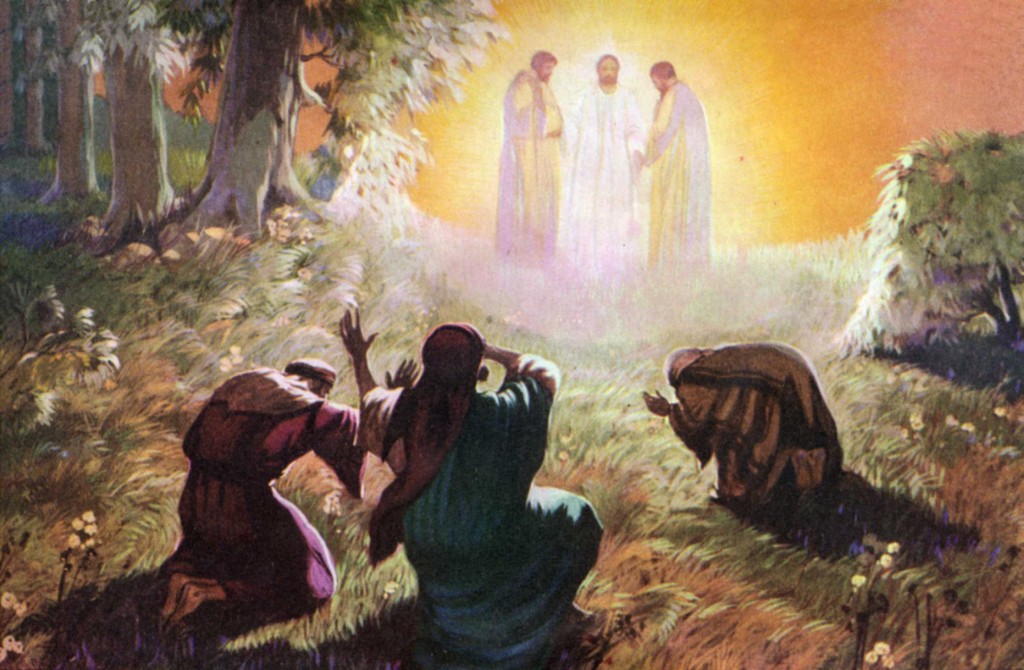
The Transfiguration is an event that was memorable for the disciples who were present to it. The Second Reading tells of Peter recalling: "We ourselves heard this voice come from heaven, while we were with him on the holy mountain." (2 Pet 1: 18) Nevertheless, two of the apostles who were there for the revelation of Christ's glory, fled at the time of the Passion and initially doubted the veracity of the Resurrection. So it can be with us. We are privileged to have spiritual experiences and enlightenment but we fail to understand them or see how they impact on our lives. Years later, after a period of doubt and suffering, the memory may re-surface and help to restore our faith in God. Our own transfiguration experiences therefore can serve the purpose of the Transfiguration in overcoming the scandal of the Cross in our own lives and open us up to the fulfilment of God's promises. Peter writes: So we have the prophetic meesage more fully confirmed. You will do well to be attentive to this as to a lamp shining in a dark place, until the day dawns and the morning star rises in your hearts." (2 Pet 1: 19)
17th Sunday in Ordinary Time
There are two examples of people finding treasure in the Gospel today. First, there is the accidental finding of treasure in a field. As we go along in our everyday life we can bump into God or stumble across the work of the Holy Spirit. Second, there is the intentional search for the "pearl of great price." Here the individual knows what s/he is looking for and sets out to find it. In both cases what is important is the recognition that treasure has in fact been found and the courage to take the plunge in doing whatever is required to acquire it. If you are baptised and attending Mass chances are that you are looking for the Kingdom of God. Nevetheless, have you the courage to appropriate the gift of the sacrament and the rrelationship it brings with Christ Jesus to acquire the treasure. Or, are you still weighing up the cost?
16th Sunday in Ordinary Time
Today we have another parable involving sowing but this time it is not the sowing of the Word but of evil. It helps us to understand something of the nature of evil which has plagued thinkers throughout history that has even led some people to become atheists when they despair of evil in a world where God is said to be love. Often it is interesting that those who make such a decision have not actually experienced much suffering themselves! Maybe they are more afraid of their own capacity to deal with evil rather than recognising the power of God to transform and overcome evil through love? In the parable today it is the enemy and not God who sows the evil in with the good. The evil, in fact, grows with the good and can be difficult to distinguish from it or is entangled with it. The danger is that trying to remove evil absolutely, as if we ourselves know how to do it, we will damage the good. God, who is the only true arbiter of good and evil, reserves to himself how to deal with the eventual harvest. After all it is the angels who will do the reaping (Mtt 13: 39) It is up to us as the workers to keep working the land so that the good can be brought to harvest and remain forever. In the book, Daily Prayer with Mother Teresa she states: "We deliberately renounce all desires to see the fruit of our labor, doing all we can as best as we can, leaving the rest in the hnads of God." (p. 118)
Subscribe to:
Posts (Atom)