Friday, 24 November 2017

1st Sunday of Advent

The First and Second Readings on this day, at the start of a new liturgical year, both speak of confidence in God's mercy and love. In the First Isaiah is mindful of the failings of the people and longs for the Messiah to vindicate God's rule: "O that you would tear open the heavens and come down, so that the mountains would quake at your presence." (Is. 64: 1) In the Second St Paul encourages the Corinthians to be faithful so they may continue in their faith until the Lord returns as he promised: "He will strengthen you to the end, so that you may be blameless on the day of our Lord Jesus Christ." (1 Cor 1: 8) Surrounded as we are with all the tinsel and blandishments of consumerism it is possible for us to lose heart. The apostasy of Western civilization to materialism, scientism and other idealogies antithetical to the Gospel can cause us sadness. How could people who have known the hope of the Gospel turn aside to other gods and other empty promises?: "Has a nation changed its gods, even though they are no gods? But my people have changed their glory for something that does not profit. Be appalled, O heavens, at this, be shocked, be utterly desolate, says the LORD, for my people have committed two evils: they have forsaken me, the fountain of living water, and dug out cisterns for themselves, cracked cisterns that can hold no water." (Jer. 2: 11-13).The answer is for us, in this season of preparation, to renew our trust in God and in his ways: "Yet, O Lord , you are our Father; we are the clay, and you are our potter; we are all the work of your hand." (Is. 64: 8) We do this through prayer and alms giving along with a reaffirmation in the power of God to save even when, as we see in the lead up to Jesus' birth, that all appeared to be lost.


Monday, 20 November 2017

Christ the King

It is difficult for us to appreciate what a king would have meant to people in the time of Jesus. The early Christians saw Jesus primarily as the Good Shepherd and later on as the Pantocrator - ruler of the Universe. The latter would have been influenced by the new status of Christianity under the emperor Constantine. Today's feast, however, is not an ancient one. It was instituted by Pope Pius XI in 1925 amid the rise of fascism in Europe. Benito Mussolini had come to power on 1922. Jesus reign as Universal King began at the Crucifixion and he is enthroned on his Cross. Conquering sin and death he did as he prophesied: "Now is the judgment of this world; now the ruler of this world will be driven out. And I, when I am lifted up from the earth, will draw all people to myself." (Jn 12: 31-32) Sin no longer reigns unopposed in this world but continues to struggle and win over people to the rule of Satan. Nevertheless, the end of the Universe is clear: "And just as it is appointed for mortals to die once, and after that the judgment, so Christ, having offered once to bear the sins of many, will appear a second time, not to deal with sin, but to save those who are eagerly waiting for him." (Heb 9: 27-28) The question is whether we are prepared for when the King returns? Have we manifested the fruit of his grace in our lives?


Sunday, 12 November 2017

33rd Week in Ordinary Time

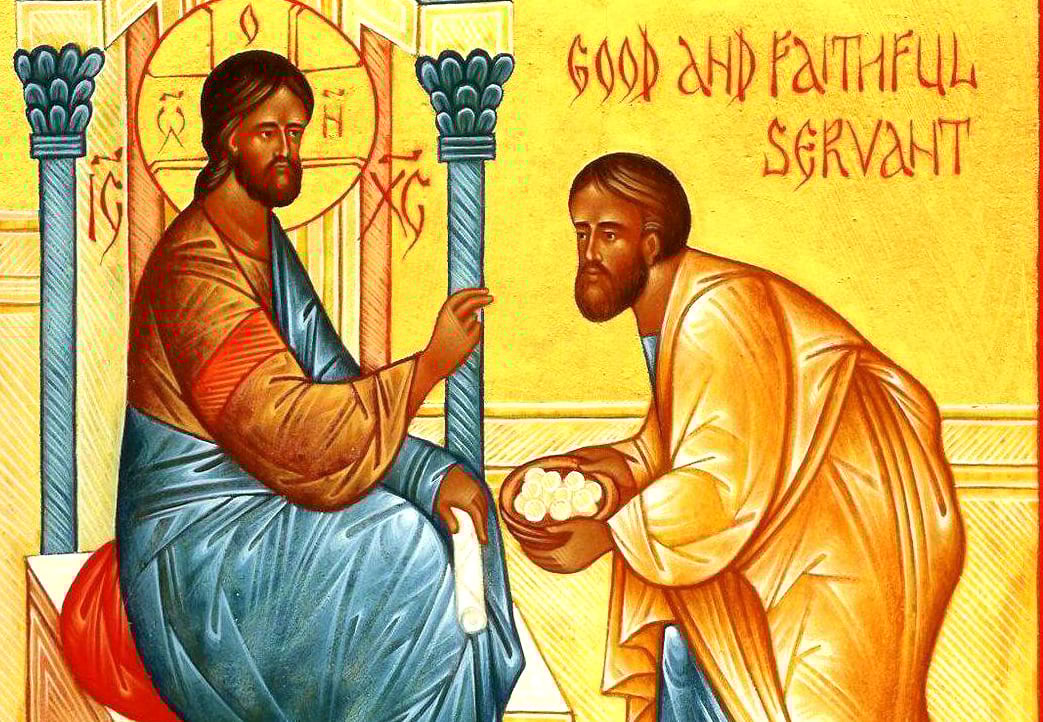
There is an attitude in our society and even sometimes among churchgoers that if there is life after death, however you might think of it, everyone will enter beatitude - no questions asked. In other words, there is no sense that there is a judgement or accountability for what we have done during our lives. St Paul is clear on this: "For all of us must appear before the judgment seat of Christ, so that each must receive recompense for what has been done in the body, whether good or evil." (2 Cor 5: 10) In today's Gospel the Lord says: "For to all those who have, more will be given, and they will have an abundance; but from those who have nothing, even what they have will be taken away." (Mtt 25: 29) God cannot lie! He will not invent a life of good deeds and truth when what was there was in fact a lie. Such people who lack any reception of God's grace will experience further loss in eternal death while those who have cooperated with grace will receive even greater grace in eternal life. The onus is on us, assisted by grace, to use that beautiful gift to love God and our neighbour in such a way that we all hear the words: "Well done, good and trustworthy slave; you have been trustworthy in a few things, I will put you in charge of many things; enter into the joy of your master." (Matt 25: 23)


Sunday, 5 November 2017

32nd Sunday in Ordinary Time

Recently I spoke to a woman who was back in Whanganui visiting her elderly mother who was unwell. One of five siblings she left the others behind as she came to the Vigil Mass. They said to her: "You can go for us." Today's gospel reminds us that such an attitude is not a valid one for the Kingdom of Heaven. Catholics all have the lamp of faith through baptism yet not all are wise. The oil of prayer and the sacraments keeps the lamp of faith burning throughout our lives. Those Catholics are foolish who neglect the obligation of their religion and coast along oblivious to the danger that they will be bereft when the time comes whether it be of trial, sickness or even death. I remember a saying of the lay evangelist Jan Heath who said: "God has children. He does not have grandchildren." It is incumbent on all the baptized to appropriate their faith and to live it out according to the gifts given them by the Holy Spirit. It is true that: "For by grace you have been saved through faith, and this is not your own doing; it is the gift of God - not the result of works, so that no one may boast" (Eph. 2: 8-9), however, we also need to cooperate with grace to accomplish the redemption offered us in Christ. "Besides this, you know what time it is, how it is now the moment to wake from sleep. For salvation is nearer to us now than when we became believers; for the night is far gone, the day is near. Let us then lay aside the works of darkness and put on the armour of light; let us live honourably as in the day, not in reveling and drunkenness, not in debauchery and licentiousness, not in quarreling and jealousy. Instead, put on the Lord Jesus Christ, and make no provision for the flesh, to gratify its desires." (Romans 13: 11-14)


Wednesday, 1 November 2017

31st Week in Ordinary Time

Having just dealt severely to the challenges of the Pharisees and other opponents Jesus, in this week's Gospel, actually affirms them! He acknowledges their legitimacy as teachers since they "sit in Moses' chair." (Mtt 23: 2) however he does not recommend that his disciples emulate their conduct. I think everyone would be aware that not all Pharisees would be self-seeking, hypocritical, pretentious, social climbing sycophants, however, the behaviours described would not be unknown then and even now. This is ultimately the point. The message is not for the Jews, it is for us. As disciples we must not fall into the traps that ensnare individuals living in faith communities and churches. We are challenged to live as Christ lived for we have been warned. It is not a question of "if" or "maybe" rather: "All who exalt themselves will be humbled, and all who humble themselves will be exalted." (Mtt 23: 12) 


Friday, 27 October 2017

500th Anniversary of the Reformation

In this parish there will be, tomorrow, a symposium on the effects of the Reformation with speakers from the Catholic and Lutheran communities leading us. Many people still struggle to deal with the theological questions of the history and prefer to focus on things like the corruption of the papacy and the sale of indulgences. At a theological level the issue is fundamentally that of mediation. The Protestant ideas of sola scriptura, sola fide and sola gratia downplay, if not excluding altogether, the actions of human beings in cooperating with God's saving plan. Martin Luther saw salvation and redemption as an opus Dei - the work of God.This, ultimately, has serious implications for our faith. I like Yves Congar's comment on this issue:

"But if neither the human race as such, nor the Church, nor Our Lady has any active part in the work of salvation the question cannot but occur what of the cooperation of Christ's human nature? If we disagree about the Church and Our Lady for the same reason as we do about the idea of a pure opus Dei in which God alone is active in the work of salvation, this third problem must be faced. Are we not also in disagreement about the part played by Christ's humanity in the same work? [...] For if salvation is wholly an opus Dei, the sole act of God, what becomes of the part played by Christ's humanity itself, since our own part, and the parts of Our Lady and the Church are held to have no place. God, according to Luther, does our work in us. Faith, the one thing that should respond to us to God's action is, in his view, itself the work of God."

The danger of such a theology, therefore, lies in a denial of Christ's humanity and bodiliness. That is a heresy called Docetism. The work of salvation is spiritualised to such an extent that we are in danger of being captured by subjectivism and newer forms of gnosticism - the secret knowledge of the Scriptures frees us from sinful material reality and elevates us to the spiritual realms far away from the messiness of the material world. God can also become so distant and inaccessible that he is no longer Abba - Father. We turn in on ourselves, as a result, and our faith becomes a projection of our own needs and desires rather than the objective revelation of God's love for us in Christ Jesus and the hope of a resurrection of the body.


Monday, 23 October 2017

30th Sunday in Ordinary Time

Looking at the three controversies in the Gospel of Matthew we can see that prior to today's Gospel there was the question of paying taxes then the issue of the Resurrection followed by the present topic of the Law. Next, there would be the Messiah, although this is omitted in our lectionary for Year A, as is the gospel on the dispute with the Sadducees. All of these were controversial to the various parties present at the time of Jesus and thus required a response from him and his followers as they proclaimed the Gospel. Jesus is remarkably concise in what he says and uses the Torah to great effect. He does not try to evade the issue at point nor does he engage in extended moralizing. His attitude and method serves for us today as we need to defend the faith and articulate the Good News to a hardened and often cynical world: "Always be ready to make your defense to anyone who demands from you an accounting for the hope that is in you; yet do so with reverence. Keep your conscience clear, so that, when you are maligned, those who abuse you for your good conduct in Christ may be put to shame. For it is better to suffer for doing good, if suffering should be God's will, than to suffer for doing evil." (1 Peter 3: 15-18)